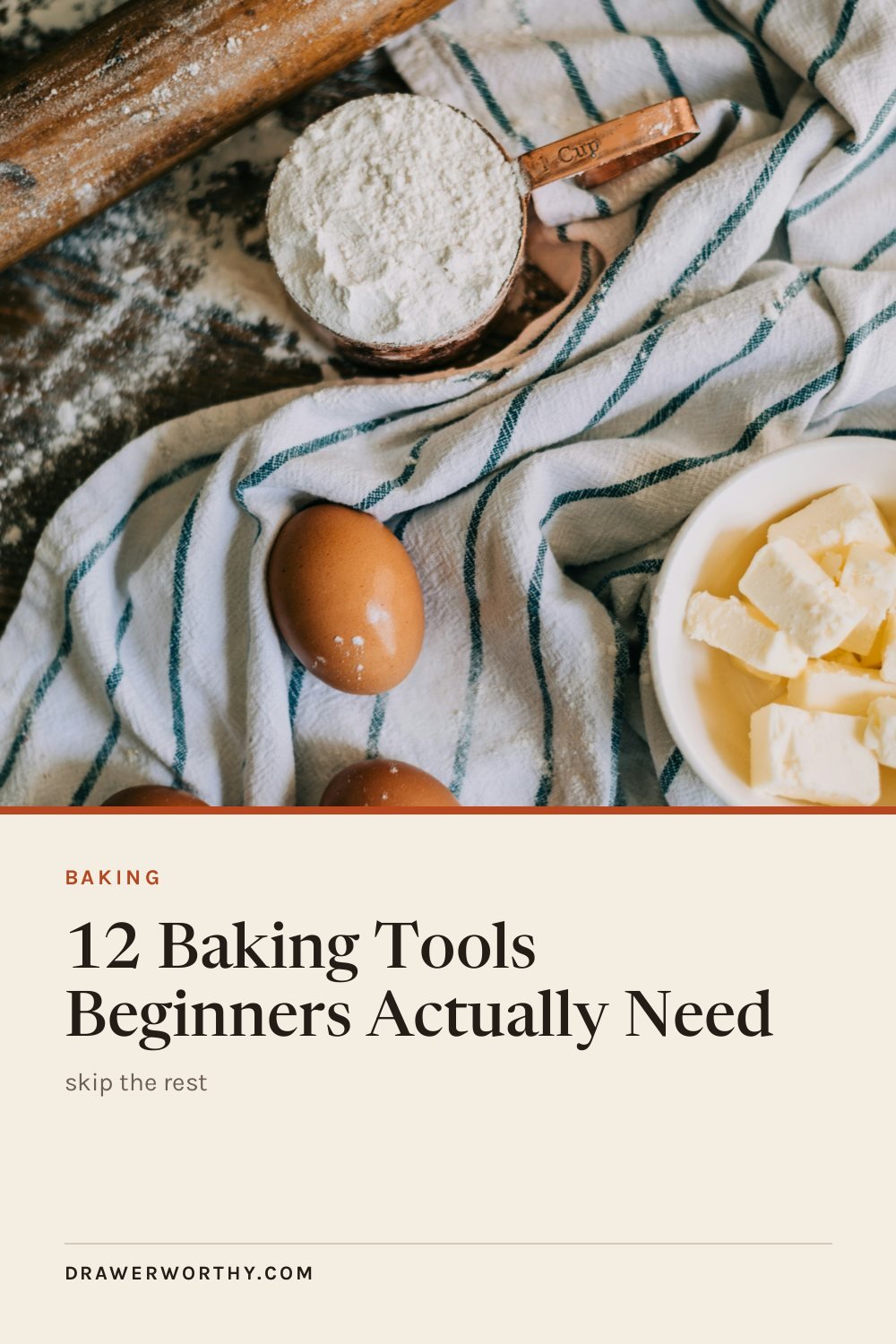
12 Baking Tools Beginners Actually Need (Skip the Rest)
As an Amazon Associate I earn from qualifying purchases. Product links below go to Amazon. Full disclosure.
Part of our complete kitchen gadget guide.
Baking rewards precision more than any other kind of cooking, which is why the right basic tools matter more than the fancy ones. This is the short list worth owning before anything else, and it is deliberately short.
Beginner baking lists are usually padded with equipment that only matters once you bake every week. Each tool here has to be needed in the first few recipes a new baker attempts, and has to change the result rather than only the convenience.
The short answer
- Buy this first: a digital scale. Baking is chemistry and cups are not a measurement.
- Second: two heavy half sheet pans.
- Most overlooked: a cooling rack, which decides whether the bottom goes soggy.
- Skip for now: the stand mixer. Reasons at the bottom.
How these were chosen
Every item here appears in the first ten recipes almost any beginner bakes: cookies, banana bread, brownies, a simple loaf, a traybake. Anything that only matters for laminated pastry, sourdough, or decorating was left out, because those are decisions for later and buying for them now means owning tools you cannot yet use.
Where the cheap version performs identically to the expensive one, that is said plainly. Baking equipment has an unusually large gap between what costs money and what changes results, and most of the difference sits in two places: even heat and accurate measurement.
1. A digital kitchen scale

Flour is the reason two people follow the same recipe and get different cakes. Scooped from the bag it can vary enormously depending on how packed it is, and that difference is the gap between a tender crumb and a dry one. Weighing removes the variable entirely, which is why nearly every reliable recipe is written in grams. It also means fewer dirty measuring cups and easier scaling of a recipe up or down. It costs less than almost anything else here.
Best for: Every beginner baker, without exception
Why it made the list: It fixes the largest single source of inconsistency in baking
Keep in mind: Kitchen scales measure to one gram, which is right for baking. You do not need finer precision unless you are dosing espresso.
2. Two heavy half sheet pans

Thin baking trays warp in a hot oven, and a warped tray makes cookies slide into each other and cakes bake unevenly. Heavy gauge aluminium stays flat and conducts heat evenly, which is most of what a baking tray needs to do. Two rather than one, because rotating batches means the second is loaded while the first bakes, and because a lot of recipes need both at once.
Best for: Cookies, traybakes, roasted anything
Why it made the list: Even heat and no warping, which is the whole job of a baking tray
Keep in mind: Dark non-stick trays brown the bottoms faster and can overbake cookies. Uncoated aluminium is the safer default.
3. Parchment paper or a silicone mat

Either one stops food welding itself to the tray and makes cleanup close to nothing. Parchment is disposable and better when you want a crisp bottom; a silicone mat is reusable and gives more even browning underneath. Most bakers end up with both. Starting with one is fine, and which one depends on whether you would rather save money over time or have the option to bake directly on metal.
Best for: Everything baked on a tray
Why it made the list: It removes sticking and cleanup, which is where beginner enthusiasm usually dies
Keep in mind: Silicone mats hold oil smells over time and will never crisp a base the way bare metal does.
4. A set of nesting mixing bowls

Most recipes need wet and dry ingredients separated before they meet, so a single bowl means washing up mid-recipe. A nesting set of three gives you room to work and stores as one item. Glass or stainless are both fine; stainless is lighter and will not shatter, glass lets you see what is happening at the bottom.
Best for: Every recipe more complicated than melting butter
Why it made the list: Baking is sequential, and one bowl breaks the sequence
Keep in mind: Plastic bowls hold grease no matter how well you wash them, which ruins egg whites. Avoid them if you plan to whip anything.
5. A balloon whisk

A whisk does something a spoon cannot: it incorporates air, which is what makes cakes rise properly and cream hold. A wide balloon shape with plenty of wires moves the most air. For most beginner recipes this and a spatula are the only mixing tools you need, which is worth knowing before anyone sells you a machine.
Best for: Batters, eggs, cream, and anything that needs lightening
Why it made the list: It performs a function a spoon physically cannot
Keep in mind: Whisking cream or egg whites by hand is genuinely tiring. This is where an inexpensive hand mixer earns its place, long before a stand mixer does.
6. A silicone spatula

Baking is measured, so batter left in the bowl is missing from the tin. A flexible silicone spatula gets nearly all of it, folds delicate mixtures without knocking the air out, and handles heat well enough for stovetop custards and caramels. Buy a one piece moulded spatula rather than a two part one where the head glues to a handle, because that seam traps food and stays dirty.
Best for: Folding, scraping, and any recipe where quantities matter
Why it made the list: It protects the accuracy you got from weighing in the first place
Keep in mind: Two piece designs with a removable head are the ones to avoid. Food gets into the join and does not come out.
7. A cooling rack

Leaving baked goods on the hot tray keeps cooking them, and sitting them on a plate traps steam underneath, which is exactly how a good cookie develops a soggy base. A wire rack lets air circulate on all sides so the bottom sets properly and the texture you baked for survives. It is inexpensive, almost never mentioned in beginner lists, and it changes the result more than most of the equipment that is.
Best for: Cookies, cakes, breads, anything that comes out of a tin
Why it made the list: Air underneath is the difference between crisp and soggy
Keep in mind: It is another item to store. A rack that fits inside your sheet pan solves that and doubles as a roasting rack.
8. Measuring spoons

Baking soda, baking powder, salt, and yeast are used in tiny quantities and getting them wrong is obvious in the result. A scale is not practical below a few grams, which is exactly where spoons take over. Choose a set with engraved rather than printed markings, because printed ones wear off in the dishwasher and an unlabelled spoon is useless.
Best for: Every recipe with a raising agent
Why it made the list: The one place where volume measurement is genuinely better than weight
Keep in mind: Level them properly. A heaped teaspoon of baking soda can be almost twice a level one, which is enough to taste.
9. A rolling pin

A straight wooden dowel pin gives more feel and control than a heavy barrel with handles, and it is easier to store and to clean. For pastry, biscuits, and cinnamon rolls it is all you need. The handled kind is not wrong, but the parts that make it feel substantial are also what make it awkward to steer.
Best for: Pastry, cut-out biscuits, anything rolled
Why it made the list: Cheap, effective, and easier to control than the more impressive looking option
Keep in mind: Wooden pins should not be soaked or put in a dishwasher. Wipe and dry them, or they will crack.
10. A loaf tin and a square tin

Banana bread, quick breads, and simple loaves need a loaf tin. Brownies, traybakes, and bar cookies need a square or rectangular one. Between them these two cover most of what a beginner bakes, which is why buying a set of eight tins is a mistake. Choose light coloured heavy metal, and check the size against the recipes you plan to bake, since a tin an inch off changes bake times noticeably.
Best for: Banana bread, brownies, traybakes, simple loaves
Why it made the list: Two tins cover the majority of beginner recipes
Keep in mind: Glass and ceramic dishes hold heat differently to metal, so a recipe written for a metal tin will need a lower temperature or a longer time.
11. An instant-read thermometer

A loaf that looks perfect can still be raw in the middle, and the only reliable way to know is internal temperature. Most breads are done in a fairly narrow range, and a thermometer removes the guessing that makes beginners either cut into loaves too early or overbake them into dryness. It is the same tool covered in the under twenty five guide, doing a different job.
Best for: Anyone baking bread, or custards and curds
Why it made the list: It answers the question that beginner bakers most often get wrong
Keep in mind: The cheapest models drift out of accuracy over time and usually cannot be recalibrated.
12. A bench scraper

For anything involving dough, this does three jobs: it divides and portions, it lifts sticky dough off the counter without stretching it, and it scrapes the surface clean afterwards in one pass. It is one of the cheapest tools in any kitchen and one of the most used by people who bake regularly. It also appears in our lesser known gadgets guide, because most home cooks have never owned one.
Best for: Bread, biscuits, pastry, anything that starts as dough
Why it made the list: It handles sticky dough in a way hands and knives cannot
Keep in mind: It is not useful if you only bake cakes and batters. Buy it when you start working with dough.
The one we would skip, for now
The stand mixer as a first purchase
Stand mixers are excellent machines and they are the wrong first purchase. They cost more than everything else on this page combined, they occupy permanent counter space, and almost nothing a beginner bakes actually requires one. Cookies, banana bread, brownies, muffins, and traybakes are all mixed by hand in the recipes they come from.
A stand mixer earns its cost in two situations: heavy bread dough kneaded regularly, and frequent baking in quantity. Both are things you discover after a year, not before. Until then a hand mixer costs a fraction as much, lives in a drawer, and does the one job hand whisking is genuinely tiring for, which is whipping cream and egg whites.
The same logic applies to decorating kits, specialist tins, and silicone moulds for shapes you have not baked yet. Buy them when a recipe you actively want to make requires them. Equipment bought for the baker you intend to become mostly stays in the cupboard.
Frequently asked questions
Do you need a stand mixer to start baking?
No. Most beginner recipes are mixed by hand or with an inexpensive hand mixer. A stand mixer earns its cost with heavy doughs and frequent baking, which is a later problem rather than a first one.
Why does a kitchen scale matter so much in baking?
Flour packs differently every time it is scooped, so the same cup can hold noticeably different amounts. Weight removes that variation, which is why most reliable recipes are written in grams and why two people following the same recipe with cups get different results.
What can beginners safely skip?
Specialist tins, decorating kits, silicone moulds, and sifters. A whisk aerates flour perfectly well for beginner recipes. Buy specialist equipment when a recipe you want to make actually requires it.
Is expensive bakeware worth it?
Only where it buys even heat. Heavy gauge pans that do not warp are worth paying for. Beyond that, the gap between mid-priced and premium bakeware shows up in appearance and longevity rather than in how your cake turns out.
What to buy first
The scale and two sheet pans. Between them they cost very little and they cover accuracy and even heat, which are the two things that decide whether a beginner recipe works. Add parchment, a bowl set, a whisk, and a spatula and you can bake almost anything a beginner would want to.
Then bake for a few months before buying anything else. What you reach for repeatedly will tell you what to buy next far more reliably than any list, including this one.
More guides worth reading
- Best Kitchen Gadgets Under $25: 12 That Earn Their Drawer Space
- Best Gifts for People Who Love Cooking
- 15 Kitchen Gadgets You Didn’t Know You Needed (And 1 to Skip)
If you want the short version of this list with specific picks, see best baking tools under $25, and for scales in detail, the best kitchen scale for home cooks.