Best Instant-Read Thermometer for Home Cooks: 5 Picks (And the Dial One to Retire)
As an Amazon Associate I earn from qualifying purchases. Product links below go to Amazon. Full disclosure.
Part of our best kitchen gadgets under $25 guide.
An instant-read thermometer is the second thing we tell people to buy, after a scale. It ends the guessing. Chicken comes out cooked through and not dry, steak comes out the way you wanted it, bread is done in the middle, and you stop cutting into things to check. Most home cooks who buy one say the same thing a month later: they did not realise how much they had been overcooking.
The good news is that this is a solved product. A fast, accurate thermometer costs less than a takeaway. This guide explains the three things that separate a good one from a frustrating one, gives five picks, and names the type to skip.
The short answer
- Buy this for most kitchens: the Alpha Grillers. Fast enough, accurate enough, the most-reviewed thermometer on Amazon, and cheap.
- If you want the fastest reading: the ClimeCo 0.5-second. Half a second is genuinely quicker in practice when you are holding your hand over a hot pan.
- For roasts and bread: the ThermoWorks DOT, a leave-in probe with an alarm. A different tool for a different job.
- Skip: the dial thermometer from the drawer. It takes thirty seconds to settle and is often wrong.
What actually matters in an instant-read thermometer
1. Speed, but only to a point
A reading that takes ten seconds means ten seconds with your hand over a hot pan or the oven door open. Anything under three seconds is comfortable. Under one second is nicer but it is the difference between good and slightly better, not between usable and not. Ignore claims of accuracy to a tenth of a degree; you are checking whether chicken is over 74 degrees, not calibrating a lab.
2. A thin tip
The sensor sits in the tip of the probe, and a thin tip reads the actual centre of a chicken thigh or a thin fillet instead of averaging the whole thing. It also leaves a smaller hole, which matters for steak. Look for a probe that narrows to a point rather than a uniform thick rod.
3. A display you can read in a hurry
Big digits, a backlight for the barbecue, and ideally a display that rotates when you hold it left-handed or upside down over a pan. Folding probes are worth having because they protect the tip in a drawer and turn the thermometer on when you open them, which is one less button.
What does not matter much
Bluetooth and apps on an instant-read. You are holding it in your hand; the number is right there. Rechargeable batteries, which add a cable and a reason for it to be flat; a coin cell lasts a year or more. Preset temperature charts printed on the body, which are usually American USDA figures and not always what you want for a medium-rare steak.
The five we would buy
1. Best for most kitchens

Reads in two to three seconds, folds to protect the tip, has a backlight and a magnet for the fridge door, and is waterproof enough to rinse under the tap. It is the most-reviewed thermometer on Amazon and it earned that by being good and cheap rather than clever. The tip is thin enough for fillets.
Best for: Anyone who does not own a thermometer yet
Why it made the list: The best value on the market, and it does the whole job
Keep in mind: Two to three seconds, not half a second. For most cooking that is fine.
2. Fastest reading
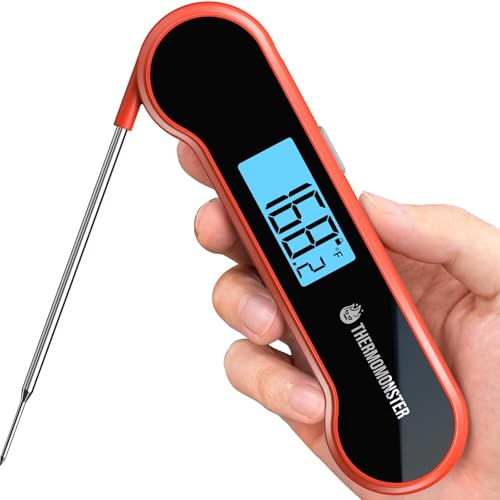
Half a second from probe to number, which you notice when checking several pieces of meat on a grill or testing a batch of frying oil. The display rotates automatically so it reads correctly whichever way you hold it, and the probe is thin. Waterproof, folding, magnetic.
Best for: Barbecue, frying, and anyone who checks a lot of pieces at once
Why it made the list: The speed is real, and the auto-rotating display is the best feature on any thermometer here
Keep in mind: Costs more than the Alpha Grillers for a speed difference that matters on a grill and barely at all on a weeknight.
3. Best backup and gift

One-second readings, a folding probe, a bright backlit display, and a price that makes it an easy gift or a second thermometer for the barbecue. Over fifty thousand reviews and a reputation for surviving being dropped.
Best for: A second thermometer, a stocking filler, or a first one for someone who will not spend more
Why it made the list: The same job as the pricier ones for a few dollars less
Keep in mind: The probe is slightly thicker than the two above. Fine for chicken and roasts, less good for thin fish.
4. Most accurate
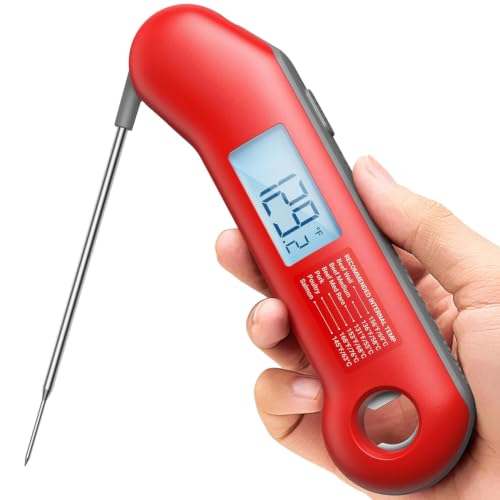
Accurate to half a degree Fahrenheit and it holds that across the range, which matters if you temper chocolate, make sugar syrup, or care about steak to the degree. Half-second readings, a large rotating display, and a metal body that feels like a tool rather than a toy.
Best for: Confectionery, sous vide checks, and cooks who want the number to be right
Why it made the list: Lab-level accuracy at a kitchen price
Keep in mind: More thermometer than most people need. If you are checking chicken, buy the Alpha Grillers and spend the difference on a scale.
5. For roasts and bread: a leave-in probe

A different kind of thermometer. The probe stays in the roast, the cable runs out of the oven door, and the unit on the counter beeps when the meat hits the temperature you set. No opening the oven, no guessing when a joint or a loaf is done. One button, one dial, big numbers. ThermoWorks makes the thermometers restaurants use and this is their simplest one.
Best for: Roast chicken, joints, bread, and anything that takes more than half an hour in the oven
Why it made the list: Solves the one job an instant-read cannot, and does it with no app
Keep in mind: It is not a replacement for an instant-read. Most kitchens end up with one of each.
What to skip
Analogue dial thermometers. They take twenty to thirty seconds to settle, they drift out of calibration, and the dial is hard to read at a glance. The only reason to own one is if you are checking an oven, and there is a better tool for that in our baking tools guide.
Bluetooth instant-reads. A probe in your hand does not need to talk to your phone. The app adds cost and battery drain and the thermometer keeps working after the app is abandoned, so you have paid for nothing.
Thermometer-and-spatula combinations. The sensor ends up in the wrong place for both jobs.
Frequently asked questions
What temperature should chicken be?
74 degrees Celsius, or 165 Fahrenheit, at the thickest part, away from the bone. Take it out a couple of degrees early because it keeps cooking as it rests.
How do I check my thermometer is accurate?
Put the probe in a glass of ice water with plenty of ice. It should read 0 degrees Celsius or 32 Fahrenheit within a degree. Most digital thermometers have a small calibration button if it does not.
Where do I put the probe?
Into the thickest part of the meat, from the side for thin cuts so the tip sits in the centre rather than passing through. Avoid bone and the pan, both of which read hotter than the meat.
What to buy first
If you have no thermometer, the Alpha Grillers, today. If you roast or bake bread often, add the DOT. Everything else on this list is a nicer version of the first pick, not a different answer.
A thermometer and a kitchen scale together cost less than a mediocre pan and fix the two things that make cooking feel harder than it is: measuring and knowing when food is done. Both are in our under-$25 list.