Best Kitchen Scale for Home Cooks: 5 Picks and the 3 Things That Actually Matter
As an Amazon Associate I earn from qualifying purchases. Product links below go to Amazon. Full disclosure.
Part of our best kitchen gadgets under $25 guide.
A kitchen scale is the cheapest way to make your cooking repeatable, and it is the one tool we recommend before anything else. Cups lie. A cup of flour can vary by thirty grams depending on how you scoop it, and thirty grams is the difference between bread that rises and bread that does not. A scale also means fewer dishes, because you zero it between ingredients and build everything in one bowl.
The good news is that the scale market is boring in the best way. The cheap ones work. This guide explains the three things that actually matter when choosing one, then gives five picks for different kitchens, and one type to avoid.
The short answer
- Buy this for most kitchens: the Etekcity 0.1g scale. Precise enough for coffee and yeast, cheap enough not to think about.
- Cheapest that works: the Amazon Basics scale. Over a hundred thousand reviews and nothing to go wrong.
- If you bake in big bowls: the OXO with the pull-out display. It solves the one real problem every other scale has.
- Skip: anything with a raised rim, a rechargeable battery, or a smartphone app.
What actually matters in a kitchen scale
1. A flat top with no rim
A scale gets flour, oil, and sticky things on it. A flat glass or steel top wipes clean in one pass. A scale with a raised lip or a built-in bowl traps mess in the corners and is the first thing people stop using. Ignore any scale you cannot wipe with a single swipe of a cloth.
2. A display you can still see with a big bowl on it
This is the single most common complaint. Put a wide mixing bowl on a compact scale and the bowl hides the numbers. The fixes are a display set forward of the platform, a pull-out display, or simply a scale big enough that the bowl does not overhang it. Think about the bowls you actually use before choosing a small scale.
3. A sensible auto-off timer
Scales switch themselves off to save the battery. Cheap ones do it after sixty seconds, which is exactly how long it takes to find the next ingredient, and you come back to a blank screen and a bowl you have to re-tare. Two minutes or more is what you want. Some let you change it. Most do not, so check before you buy.
What does not matter much
Capacity, unless you weigh whole turkeys. Five kilos covers almost everything a home cook does. Precision beyond one gram, unless you weigh coffee or yeast, in which case 0.1 gram is useful and costs almost nothing extra. Apps, Bluetooth, and nutrition databases, which add cost, battery drain, and a reason for the scale to stop working when the app is abandoned.
The five we would buy
1. Best for most kitchens
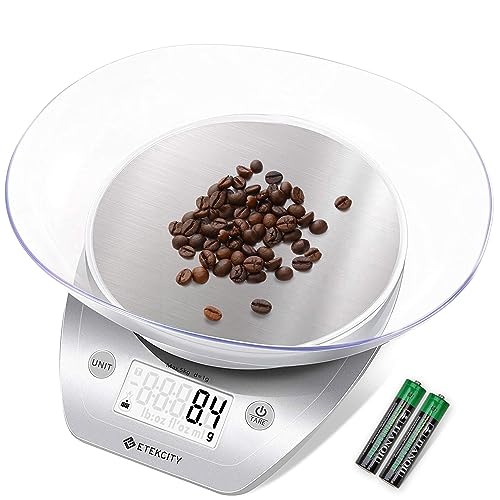
Precise to a tenth of a gram, which matters for coffee, yeast, and salt, and it costs about the same as scales that only do whole grams. The flat stainless top wipes clean. It comes with a bowl you will probably never use, and that is fine. The display sits at the front edge, so it stays visible under all but the widest bowls.
Best for: Anyone who bakes, brews coffee, or wants the same result twice
Why it made the list: The best combination of precision, cleanability, and price on the market
Keep in mind: The auto-off is shorter than we would like. Tap the platform to wake it and the tare is kept.
2. Cheapest that works

Nothing clever here, which is the point. A flat platform, a tare button, four units, and over a hundred thousand reviews saying it does what a scale should. It is accurate to a gram, which is enough for everything except coffee dosing.
Best for: A first kitchen, a second scale for the pantry, or anyone who wants to spend the minimum
Why it made the list: The most-reviewed kitchen scale on Amazon for a reason
Keep in mind: The display is on the platform itself, so a large bowl can hide it. Use a smaller bowl or read the number before you add the last ingredient.
3. Best for big bowls

The pull-out display is the fix for the problem every other scale has. Put a stand mixer bowl on it and the numbers slide out from underneath. Eleven pounds of capacity, a stainless platform that lifts off for washing, and OXO build quality. It costs three times the cheap scales and it is the one people keep for ten years.
Best for: Serious bakers, bread makers, and anyone using wide bowls daily
Why it made the list: The only scale here that solves the hidden-display problem outright
Keep in mind: Whole-gram precision only. Coffee people should pair it with a small 0.1g scale.
4. Best large platform
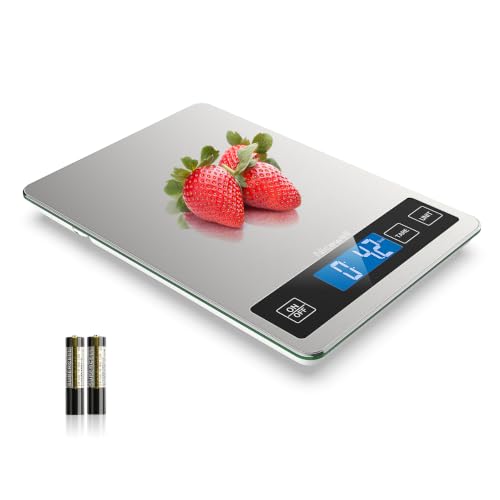
A bigger platform than most, which means mixing bowls sit on it without overhanging, and a twenty-two pound capacity for the rare times you weigh a whole roast or a batch of preserves. The display is offset to the front. Accurate to a gram.
Best for: Meal preppers weighing full containers, and anyone whose bowls are too wide for a compact scale
Why it made the list: Big platform at a small-scale price
Keep in mind: Takes up more drawer space. If your kitchen is tight, the Etekcity does the same job in half the footprint.
5. The long-term pick

A design that has barely changed in twenty years, because it did not need to. Sealed buttons, a wipe-clean top, a four-minute auto-off that is long enough to actually finish a recipe, and it runs for years on two AA batteries. It weighs to the gram up to eleven pounds and it comes in a dozen colours if that matters to you.
Best for: People who hate replacing things and want a scale that lasts a decade
Why it made the list: The longest auto-off timer here, and a reputation that predates most of the competition
Keep in mind: Whole-gram precision, and the display is on the platform, so watch the bowl size.
What to skip
Scales with built-in bowls or raised rims. They look tidy in the listing and they are miserable to clean. You will end up putting your own bowl on top anyway.
App-connected nutrition scales. The scale part is usually fine. The app part is subscription-driven, slow to open, and often abandoned by the maker within a couple of years, at which point you own an ordinary scale that cost twice as much.
Rechargeable scales. A pair of AAA batteries lasts a year or more in a scale. A rechargeable one is a device you have to remember to charge, and the one time it is flat will be the one time you are mid-recipe.
Frequently asked questions
Do I need 0.1 gram precision?
Only for coffee, yeast, and salt in small amounts. For general cooking and most baking, one-gram precision is plenty. Since the Etekcity gives you 0.1g for about the same price, there is no reason not to have it.
Why does my scale show a different weight when I move the bowl?
Scales measure the load at the centre of the platform. A bowl pushed to one edge, or a scale on a soft or uneven surface, reads wrong. Centre the bowl and use a flat hard counter.
How do I convert cups to grams?
Look up the ingredient, not a general table, because a cup of flour is about 120 grams while a cup of sugar is about 200. Better still, use recipes written in grams, which most serious baking recipes now are.
What to buy first
If you have no scale, buy the Etekcity and stop reading. If you already own a basic scale and the display keeps disappearing under your bowls, the OXO is the upgrade. Everything else on this list is a good answer to a specific kitchen, not a reason to own two.
A scale is also the first item in our under-$25 gadgets list and our baking tools for beginners guide, which tells you something about how often it comes up.