How to Organise Kitchen Drawers (Before You Buy a Single Divider)
The usual advice for a messy kitchen drawer is to buy dividers. The usual result is the same mess, now in compartments. That is because most drawer chaos is not a storage problem. It is a sorting problem, and sorting costs nothing.
This is the method we use before recommending any organiser, and it fixes about two thirds of drawers on its own. It takes an afternoon for a whole kitchen or twenty minutes for a single drawer. There are no product links on this page.
Step 1: Empty every drawer onto the table at once
Not one drawer at a time. All of them, together, on the counter or the kitchen table. This feels excessive and it is the step that makes everything else work. You cannot decide where the tongs should live until you can see that you own four pairs, and you cannot see that while three of them are in other drawers.
Wipe the drawers out while they are empty. Crumbs and grease make everything feel worse than it is.
Step 2: Sort into three piles, honestly
Used in the last month. Cutlery, the good knife, the wooden spoon, the peeler, the can opener. This pile is smaller than you expect. For most households it is fifteen to twenty-five items.
Used a few times a year. The turkey baster, the piping bags, the corn holders, the third whisk. Real, but not daily.
Not used since you moved in. Duplicates, gadgets that seemed clever, the garlic press with the broken hinge, anything you had to think about to identify. Be honest here. If you have to remember what it is for, it goes in this pile.
The third pile leaves the kitchen. Donate what works, bin what does not. The second pile goes somewhere that is not a prime drawer: a high cupboard, a box in the pantry, the drawer under the oven. Only the first pile earns space in the drawers you open every day.
Step 3: Assign drawers by where you stand
The drawer nearest the hob gets the things you reach for while cooking: spatula, tongs, wooden spoon, ladle. The drawer nearest the prep area gets knives, peeler, grater, measuring spoons. Cutlery goes nearest the dishwasher or the table, whichever is the shorter walk. Tea towels and oven gloves go by the oven.
This sounds obvious and almost nobody does it. Drawers usually get assigned when someone moves in, on the first day, before they know how they will cook in that kitchen. Reassigning them a year later is the single biggest improvement on this page.
Step 4: Put things back in a single layer
If you have to lift something to see what is underneath, the drawer is too full. Every item should be visible when the drawer is open. If the daily pile does not fit in a single layer, either the pile is too big or it needs a second drawer, and it is almost always the first one.
Long items lie front to back, not side to side, so they do not jam the drawer when it closes. Small loose things, corkscrew, bag clips, bottle stoppers, go in a small box or a cup so they stop migrating.
Now decide if you need dividers
After the four steps, look at each drawer. Most of them will be fine as they are, because a drawer holding twelve visible items does not need compartments. Two drawers usually do benefit from something:
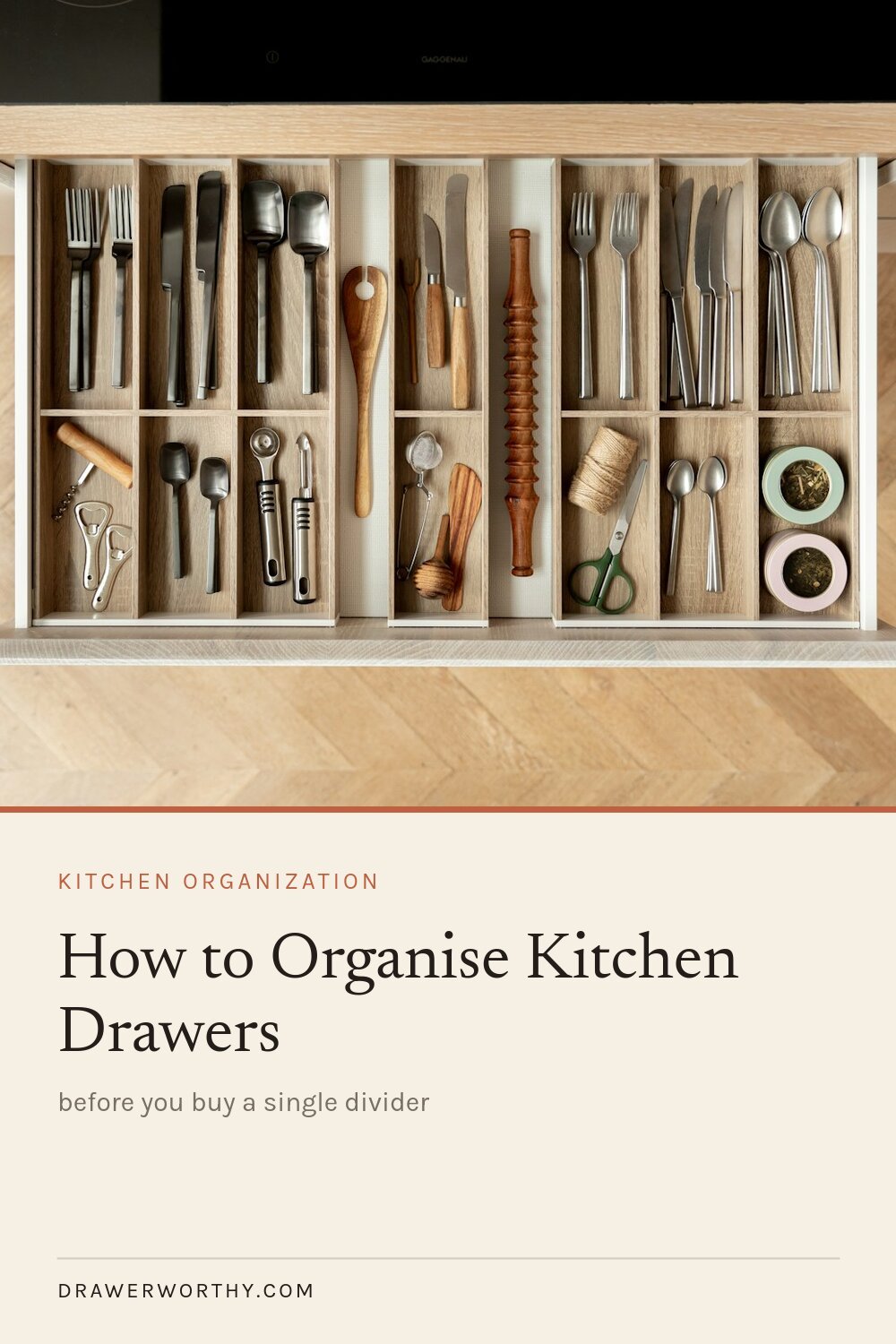
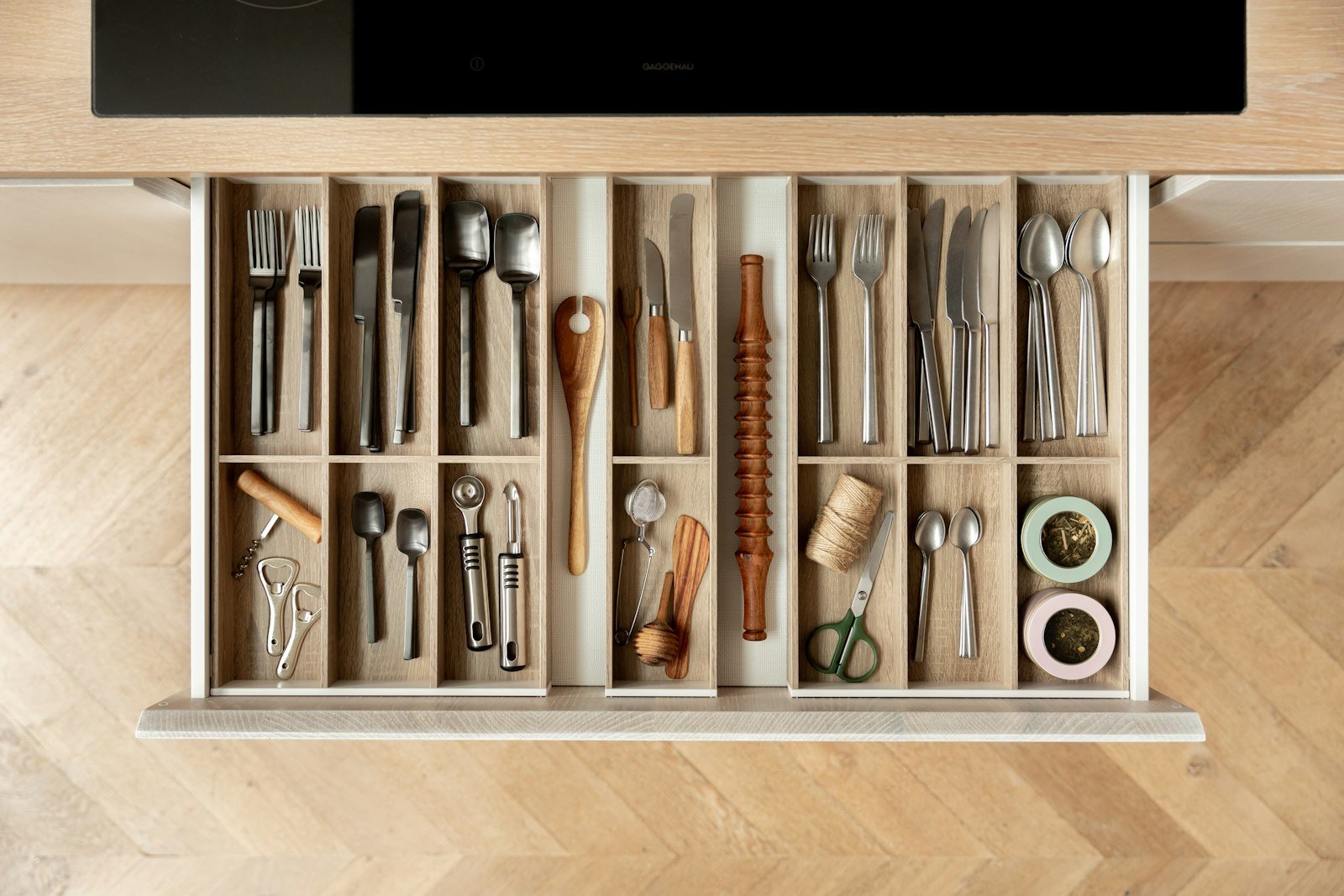
The cutlery drawer. Forks, knives and spoons genuinely need separating, and a tray is the right tool. Measure the inside of the drawer before you buy one. An expanding tray that reaches the sides stops the tray itself sliding around, which is the thing that makes cheap ones annoying.
The knife drawer, if you keep knives in a drawer. Loose knives blunt themselves against everything else and are a hazard when you reach in. An in-drawer block or a slotted insert fixes both. If you would rather free the drawer entirely, a magnetic wall strip does the same job.
Everything else, the adjustable bamboo dividers, the spring-loaded separators, the little acrylic boxes, tends to work only for people who already sorted first. Bought before sorting, they just organise clutter into smaller clutter. Our guide to kitchen organisation products covers what we would and would not buy once the sorting is done.
Keeping it that way
Drawers go back to chaos for one reason: something new comes in and nothing goes out. The rule that works is one in, one out for any drawer that is already full. A new spatula means the old spatula leaves. It sounds strict and it is the only thing that has held up in our kitchen for more than a few months.
If the whole kitchen is short on space rather than just the drawers, start with our guide to organising a small kitchen, which applies the same sort-first approach to cupboards and counters.