How to Organise a Small Kitchen (Before You Buy Any Storage)
Most kitchen organising fails in the same way. Someone spends a weekend and a lot of money on containers, the kitchen looks excellent for about three weeks, and then it slowly returns to what it was. This guide is about the order of operations that stops that happening. There are no product links on this page.
Do these three things before buying anything
1. Take everything out of one area
Not the whole kitchen. One cupboard, one drawer, one shelf. Emptying the entire kitchen at once produces a pile large enough that most people give up halfway and put it all back.
Work on the space you open most often rather than the one that annoys you most. Fixing a drawer you use twenty times a day pays you back immediately, and that feeling is what carries you into the next one. Fixing the cupboard you open twice a year feels like nothing.
2. Be honest about the year rule
If you have not used something in a year, and it is not genuinely seasonal, you will not use it next year either. That includes the gadget you bought with a plan, the pan with the ruined coating, and the fourth spatula. Almost every crowded kitchen is crowded with things that are not used, not with things that are.
The hardest category is duplicates. Most kitchens hold two or three versions of the same tool, one of which is the one you always reach for. Keep that one.
3. Group by how you cook, not by what things are
The instinct is to store all the utensils together, all the tins together, all the appliances together. It is tidier on paper and worse in practice. Group instead by task: everything you use for making coffee near the kettle, everything you use for baking on one shelf, everything you reach for while standing at the hob within arm of the hob.
The test is how many steps a task takes. If making a cup of tea involves three different cupboards, the grouping is wrong regardless of how neat each cupboard looks.
Then, and only then, measure
Once you know what is staying and where it belongs, you know what storage you actually need, and it is usually much less than you would have bought. Measure the interior of the space, not the front opening, because drawers and cabinets often narrow toward the back. Measure around obstacles like pipes under the sink rather than measuring the cabinet.
Professional organisers repeat this more than any other advice, and it is the source of most returned storage products.
The rules that keep it working
Leave empty space
A shelf filled to capacity has nowhere to put anything new, so the next thing that arrives gets put down rather than put away. That is the moment the system starts failing. Aim to leave roughly a fifth of each shelf empty.
One fixed home per item
Everything should have a single place it lives, and putting it back should take less effort than putting it down somewhere else. If returning something to its home requires moving two other things first, it will not go back.
Sight lines beat capacity
Things get lost because they cannot be seen, not because there is no room. This is why deep cupboards and corner cabinets swallow so much: the back is invisible. Anywhere you cannot see the whole contents at a glance will accumulate forgotten items, whatever storage you put in it.
Prime space for daily items
The shelf at eye level and the drawer nearest where you stand are the most valuable real estate in the kitchen. They should hold what you use daily, not what happens to fit. Occasional items go high, heavy items go low.
What to do this weekend
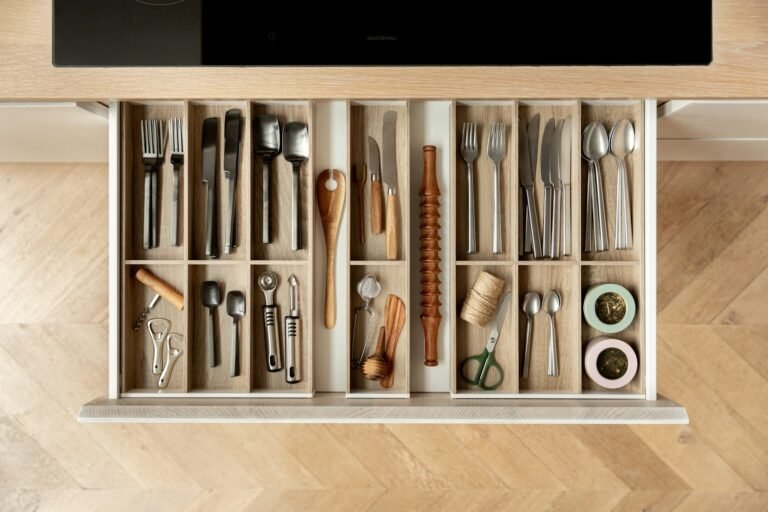
Pick your busiest drawer. Empty it, apply the year rule, group what remains by task, then measure the interior. You will have a working drawer within an hour and a clear idea of whether you need dividers, and what size.
Repeat with one space per weekend rather than trying to do the kitchen at once. When you do reach the point of buying storage, our guide to kitchen organisation products covers what holds up when full, and the small kitchen guide covers the tools worth owning when space is the constraint.
Next step: once the cupboards are sorted, our guide to organising kitchen drawers applies the same method to the drawers.