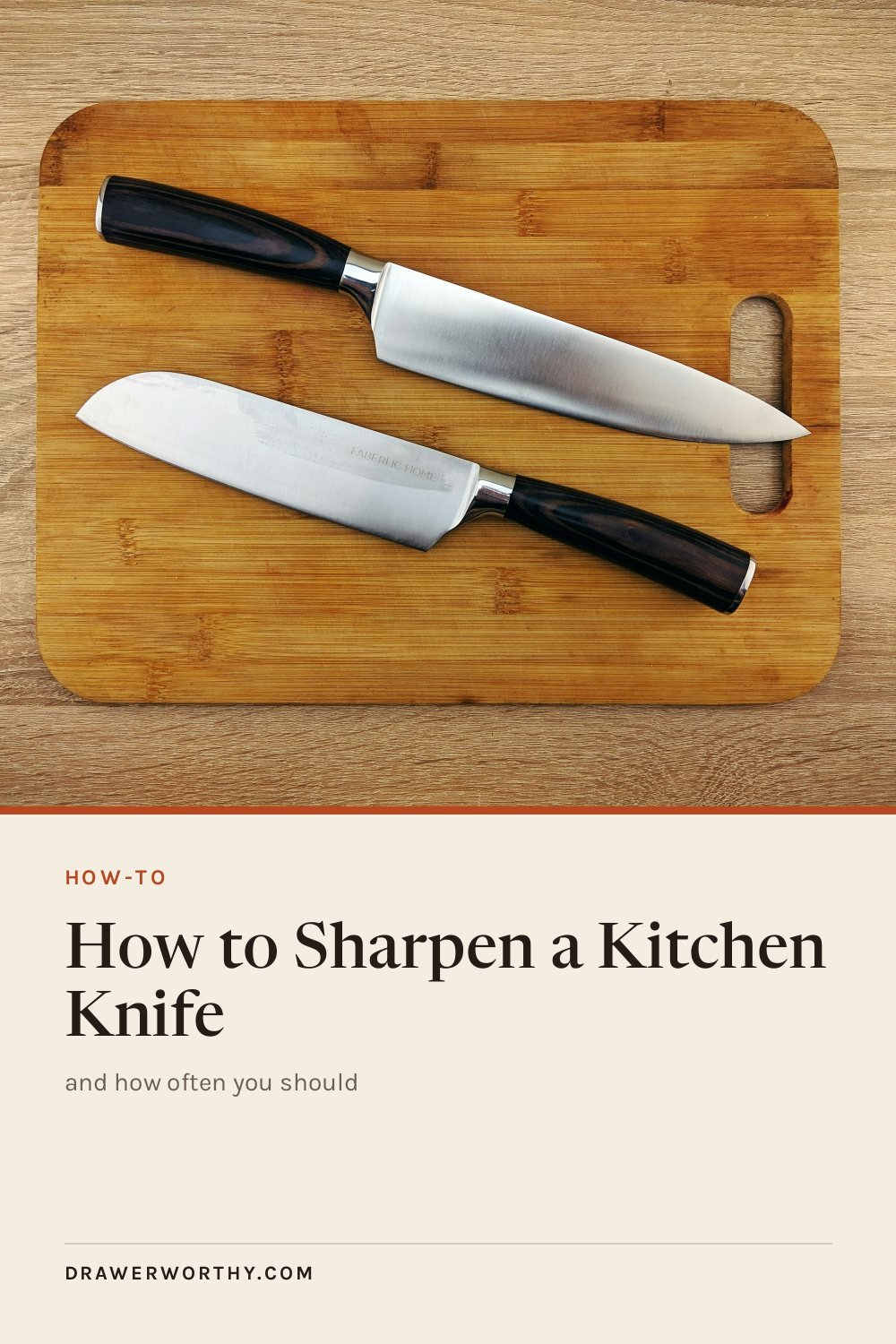
How to Sharpen a Kitchen Knife (And How Often You Should)
A dull knife is the most common problem in a home kitchen and the easiest one to fix. It makes every cut slower, it crushes food instead of slicing it, and it is more dangerous than a sharp one because it slides off the surface of what you are cutting instead of biting into it.
This guide covers what sharpening actually does, how to tell when your knife needs it, and the three ways to do it at home. There are no product links on this page.
Sharpening and honing are not the same thing
A knife edge is a very thin piece of steel. With normal use it does two things: it rolls over to one side, and it slowly wears away. Honing, with a steel rod, pushes a rolled edge back into line. It removes almost no metal and it should be done often, ideally every few uses.
Sharpening removes metal to create a new edge. It is what you do when honing no longer helps, which for a home cook is usually somewhere between twice a year and every couple of months depending on how much you cook. Most people who say their knife will not sharpen are actually honing it and expecting sharpening results.
How to tell if your knife is dull
The paper test is the simplest. Hold a sheet of ordinary printer paper by one corner and draw the knife down through it in a slicing motion. A sharp knife cuts a clean line with no effort. A dull one catches, tears, or slides off the edge without biting.
The other reliable sign is what happens to a tomato. A sharp knife breaks the skin with the weight of the blade alone. A dull one needs pressure, and pressure on a round object is how people cut themselves.
The three ways to sharpen at home
1. A pull-through sharpener
Two angled abrasive wheels in a plastic body. You pull the blade through several times and it grinds a new edge. It is the fastest and easiest option, it needs no skill, and it works.
The trade-off is that it removes more metal than necessary and it sets the angle for you, which may not match the angle your knife was ground to. Japanese knives in particular are often sharpened to a narrower angle than western pull-through sharpeners assume. For an ordinary kitchen knife used daily, this matters far less than most enthusiasts suggest.
2. A whetstone
A block of abrasive stone, usually soaked in water, that you draw the blade across at a fixed angle. It gives the best edge, it removes the least metal, and it works on any knife regardless of how it was ground.
It also takes practice. The main skill is holding a consistent angle, roughly fifteen to twenty degrees for most kitchen knives, which is about the thickness of two stacked coins under the spine. Expect your first few attempts to produce a worse edge than you started with. That is normal and it passes.
3. A honing steel, used properly
Not a sharpener, but worth including because using one regularly means you need to sharpen far less often. Hold the steel vertically with the tip on a cloth on the counter, and draw the blade down and across it at a shallow angle, alternating sides, five or six times each. Light pressure. The dramatic fast movement seen in restaurant kitchens is showmanship, not technique.
How often to do it
Hone every few uses. Sharpen when honing stops restoring the edge, which for most home cooks means two to four times a year. Cooking daily on hard boards, or cutting a lot of things with bones and seeds, moves that closer to every couple of months.
What ruins an edge fastest
Glass and stone chopping boards, which are the single worst thing you can cut on. Wood and soft plastic both give slightly under the blade; glass does not, so the edge takes the whole impact. Second is the dishwasher, where knives knock against other items and where the heat and detergent are hard on both handle and edge. Wash knives by hand and dry them.
Third is storing loose knives in a drawer, where the edges hit everything else. A magnetic strip, a block, or an in-drawer holder all solve this.
A reasonable routine
Hone before you start cooking, if you think of it. Wash and dry the knife by hand rather than putting it in the dishwasher. Cut on wood or plastic, never glass. Store it so the edge touches nothing. Sharpen properly a few times a year.
That is the whole thing. It costs almost nothing and it will make more difference to your cooking than any gadget, which is why a sharp knife is the first entry in our guide to kitchen gadgets that actually save time.
Related: how to season a cast iron skillet, the other piece of kitchen kit that gets better with basic care.