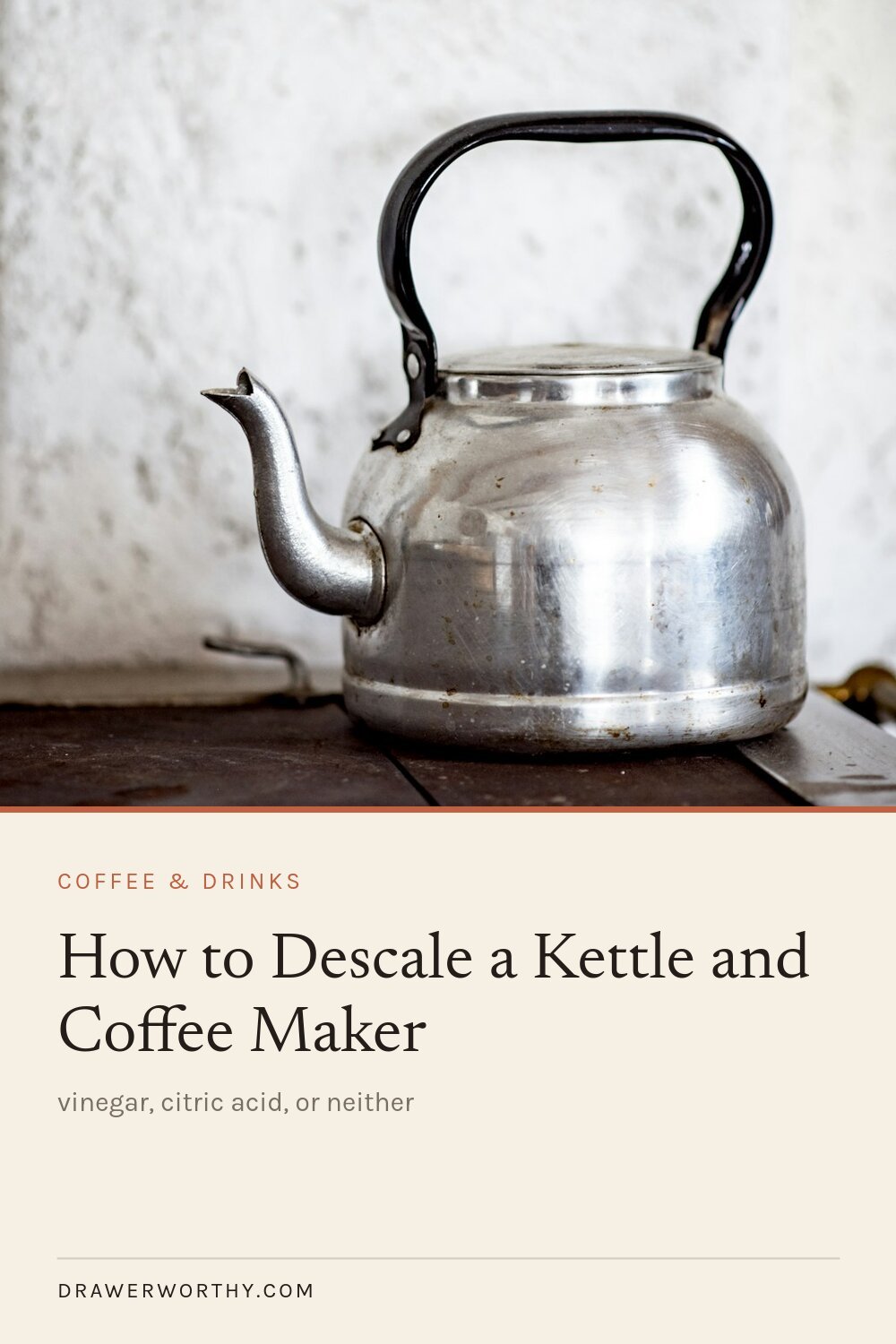
How to Descale a Kettle and Coffee Maker (Vinegar, Citric Acid, or Neither)
Limescale is the chalky white crust that builds up wherever water is heated. In a kettle it makes boiling slower and leaves flakes in your tea. In a coffee maker it clogs the heating path, drops the brewing temperature, and eventually stops the machine working at all. Most coffee machines that die early die of scale.
This guide covers how to descale both, what to use, and how often, depending on your water. There are no product links on this page.
How often, based on your water
Hard water has more dissolved calcium and magnesium, and it scales fast. If your kettle shows a white film within a couple of weeks, your water is hard. If it takes months, it is soft.
Hard water: kettle every month, coffee maker every one to two months.
Soft water: kettle every three months, coffee maker every three to four months.
Machines with a descale warning light are usually counting brews rather than measuring scale, so treat the light as a reminder, not a diagnosis. Filtered water slows scale down a lot but does not stop it.
What to descale with
White vinegar
Cheap, in every kitchen, and it works. The downsides are the smell, which lingers in coffee makers for several rinses, and that it is a weaker acid than the alternatives so it needs longer to work. Good for kettles. Acceptable for drip coffee makers. Avoid it in espresso machines and pod machines, where the manufacturers generally advise against it because it can attack rubber seals and aluminium boilers over time.
Citric acid
A white powder sold in supermarkets and pharmacies, and it is what most branded descalers are made of. No smell, rinses clean, and it works faster than vinegar. One to two tablespoons per litre of water. This is the best all-round choice and it is what we use.
Branded descaler
Usually citric or lactic acid in a bottle with instructions on the label. Fine, and sometimes required to keep an espresso machine warranty valid. It costs many times more than the powder for the same result.
Descaling a kettle
Fill the kettle halfway with equal parts water and white vinegar, or with water and a tablespoon of citric acid. Boil it, then leave it to sit for an hour, or overnight if the scale is thick. Pour it out. Any remaining crust will be soft and comes off with a cloth or a soft brush. Rinse twice, boil a full kettle of fresh water, and pour that away. Done.
If the kettle has a mesh filter in the spout, pull it out and soak it in the same solution, because that is where the flakes collect.
Descaling a drip coffee maker
Fill the reservoir with equal parts water and vinegar, or water with citric acid, and put an empty filter in the basket. Run half a brew cycle, then switch the machine off and let it sit for thirty minutes with the solution in the heating path. Switch it back on and finish the cycle. Empty the carafe.
Then run two or three full cycles of plain water. With vinegar, keep going until the steam no longer smells of it. This is the step people skip and the reason their next pot tastes odd.
Descaling an espresso or pod machine
Use citric acid or the manufacturer’s descaler, not vinegar. Most machines have a descale mode in the manual that pumps solution through the boiler in stages. Follow it, because the sequence matters: these machines hold solution inside the boiler for a set time, then flush it, and doing it by hand in the wrong order leaves acid in the system.
If your machine has a steam wand, run some solution through that as well, then flush it. Milk residue and scale together are what block steam wands.
Signs you have waited too long
A kettle that takes noticeably longer to boil, or makes a louder rumbling sound before it does. A coffee maker that brews slower, delivers less water than you put in, or makes coffee that tastes flat and lukewarm. An espresso machine that sputters or drops pressure. Any of these means the scale is thick enough to be insulating the heating element, and one descale may not clear it. Do two, a day apart.
A reasonable routine
Buy a bag of citric acid. Descale the kettle on the first of the month if your water is hard, once a season if it is soft. Do the coffee maker at the same time, every other month. It takes fifteen minutes and it is the difference between a machine that lasts two years and one that lasts ten. The same goes for the grinder, which has its own cleaning routine and is usually the bigger culprit when coffee tastes off.